debauchery
Debauchery is the state of systematic sensual excess that Jean-Baptiste Clamence adopts as a deliberate substitute for love and as a means of silencing the mocking laughter that haunts him after his moral collapse. It becomes a temporary refuge from judgment, a way to achieve a kind of immortality through oblivion, and ultimately a stage in his descent toward the invention of the judge-penitent role.
Despair of Love and the Turn to Debauchery
After his failed attempts at love and chastity, Clamence finds himself in a state of despair. He had tried to love, even developing a deceptive passion for a woman who spoke of love with the assurance of an intellectual announcing the classless society, but he realized he had been in love exclusively with himself for more than thirty years and could not lose such a habit. He multiplied promises and contracted simultaneous loves, but this only piled up more misfortunes for others. His "parrot" of a mistress even wanted to let herself die of hunger, and he had to submit to holding her hand until she found another man. Despairing of both love and chastity, he at last bethought himself of debauchery, which he describes as a substitute for love that quiets the laughter, restores silence, and above all, confers immortality.
The Mechanism of Debauchery as Liberation
Clamence explains that true debauchery is liberating because it creates no obligations. In it, one possesses only oneself; it remains the favorite pastime of the great lovers of their own person. It is a jungle without past or future, without any promise above all, nor any immediate penalty. The places where it is practiced are separated from the world; on entering, one leaves behind fear and hope. Conversation is not obligatory, and what one comes for can be had without words, often indeed without money. He freely took advantage of this liberation, living simultaneously with a mature prostitute and an unmarried girl of the best society in a hotel dedicated to what is called sin. He played the gallant with the first and gave the second an opportunity to learn the realities. He was also admitted as an equal by a masculine guild too often reviled, and he notes that even very intelligent people glory in being able to empty one bottle more than the next man.
The Pursuit of Immortality Through Excess
Clamence's debauchery is directly linked to his longing for immortality. He admits that he had always lived in debauchery, never having ceased wanting to be immortal. He was too much in love with himself not to want the precious object of his love never to disappear. Since, in the waking state and with a little self-knowledge, one can see no reason why immortality should be conferred on a salacious monkey, he had to obtain substitutes for that immortality. Because he longed for eternal life, he went to bed with harlots and drank for nights on end. In the morning, his mouth was filled with the bitter taste of the mortal state, but for hours on end he had soared in bliss. He still remembers with affection certain nights when he used to go to a sordid night club to meet a quick-change dancer who honored him with her favors and for whose reputation he even fought one evening with a bearded braggart. Every night he would strut at the bar, in the red light and dust of that earthly paradise, lying fantastically and drinking at length, waiting for dawn and ending up in the always unmade bed of his princess, who would indulge mechanically in sex and then sleep without transition. Day would come softly to throw light on this disaster and he would get up and stand motionless in a dawn of glory.
The Physical Toll and the Limits of Debauchery
Clamence's pursuit of debauchery eventually encounters an obstacle in himself: his liver, and a fatigue so dreadful that it has not yet left him. He observes that one plays at being immortal and after a few weeks one does not even know whether or not one can hang on till the next day. The sole benefit of that experience, when he gave up his nocturnal exploits, was that life became less painful. The fatigue that was gnawing at his body had simultaneously cauterized many raw spots in him. Each excess decreases vitality, hence suffering. He lived in a sort of fog in which the laughter became so muffled that eventually he ceased to notice it. The indifference that already had such a hold over him encountered no resistance and extended its sclerosis. No more emotions; an even temper, or rather no temper at all. He compares himself to tubercular lungs that are cured by drying up and gradually asphyxiate their happy owner. He was still living on his work, although his reputation was seriously damaged by his flights of language and the regular exercise of his profession compromised by the disorder of his life. He became a little fatter and at last was able to believe that the crisis was over, that nothing remained but to grow older.
The Failure of the Cure and the Return of the Cry
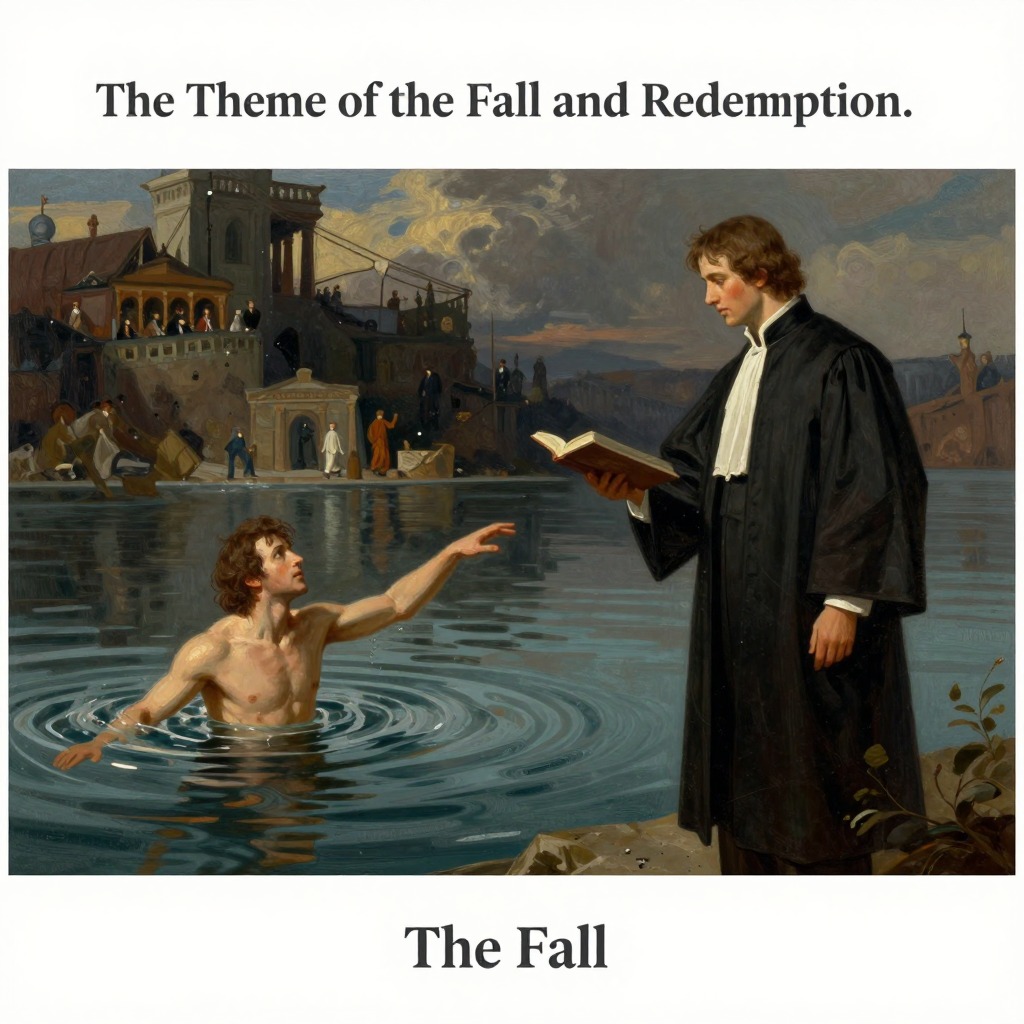
The apparent cure fails during a trip aboard an ocean liner. On the upper deck, he suddenly perceived a black speck on the steel-gray ocean and turned away at once, his heart beating wildly. He thought at once of a drowning person. Then he realized, calmly as one resigns oneself to an idea the truth of which one has long known, that the cry which had sounded over the Seine behind him years before had never ceased, carried by the river to the waters of the Channel, to travel throughout the world, across the limitless expanse of the ocean, and that it had waited for him there until the day he encountered it. He realized likewise that it would continue to await him on seas and rivers, everywhere, in short, where lies the bitter water of his baptism. He understood definitively that he was not cured, that he was still cornered and that he had to make shift with it. Ended the glorious life, but ended also the frenzy and the convulsions. He had to submit and admit his guilt, to live in the little-ease, the dungeon cell where one could neither stand nor lie down, learning that innocence consists in stretching joyously. This realization leads him directly to the invention of the judge-penitent profession, the only solution he finds to silence the laughter and avoid judgment.